
People
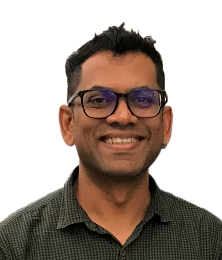
Baladevan Rangaraju
Founder and Executive Director
Bala founded India Institute in 2010 convinced that people at the margins of India’s education and legal systems deserve better information, better choices, and better institutions. His path to research ran through practice – as a teacher, school leader, and campaign director at the Centre for Civil Society, working on school choice and access to justice.
He has led field studies using randomized controlled trials, list and conjoint experiments, longitudinal surveys, and mixed-methods designs, reaching over 34,000 respondents across nine languages in India and internationally. His most-cited work, The Private School Revolution in Bihar – co-authored with James Tooley and Pauline Dixon of Newcastle University – received the Templeton Freedom Award from the Atlas Network in 2012.
He was a Visiting Researcher at Newcastle University (2022–2024) and has held a research affiliation at the Center for the Advanced Study of India, University of Pennsylvania. He holds an MA from Teachers College Columbia, an LLB from Delhi University, and a BA from Madras Christian College.

Varna Sri Raman
Lead – Research
Varna is a development economist with over two decades of experience in research, evaluation, and policy advisory across South Asia. She holds a PhD in Development Studies from the Tata Institute of Social Sciences, with training in public policy and law focused on social justice. Her work spans gender and women’s empowerment, public health, education and early learning, livelihoods, climate resilience, and air quality.
She has held research leadership roles at the American India Foundation, Evidence Action, BBC Media Action, Sesame Workshop India, and Verian (formerly Kantar Public), and has advised the Bill & Melinda Gates Foundation, GAIN, Oxfam India, and the India Health and Climate Resilience Fund.
She maintains open-source tools for MEL practitioners, including EquityStack and FieldStack, and co-founded ImpactMojo, a development education platform used by over 5,000 practitioners monthly. She is completing The Measurement Trap, a history of welfare measurement in India, and is a 2025 Dr Manmohan Singh Fellow and Terra.do Studio Climate Fellow.
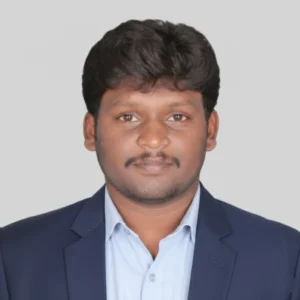
Siva Karuppasamy
Associate – Research
Siva is a researcher in public administration and political science, with a PhD from Gandhigram Rural University. His doctoral work examined local government leaders from marginalized communities, with a particular focus on the leadership styles they adopt and find most effective within their contexts.
His research interests center on the social, economic, and political conditions of marginalized groups. He has contributed as a co-researcher on multiple studies and brings strong capabilities in field-based research. His strengths include community engagement and ethnographic observation, which inform his grounded and context-sensitive approach to research.
Siva is also skilled in survey design, including the preparation of questionnaires and their programming for data collection. He is known for his collaborative approach, commitment to knowledge sharing, and an accessible, down-to-earth working style.
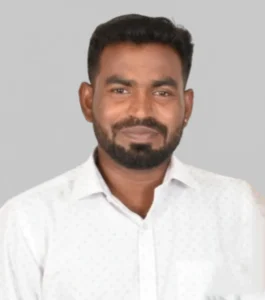
George G
Associate – Research
George’s work focuses on marginalized communities, with a particular interest in how central and state government policies translate into social change and shape lived outcomes. His doctoral research examined the impact of entrepreneurship programs on the livelihoods of manual scavengers, with a focus on pathways to social and economic mobility.
He has worked as a co-researcher and consultant on studies undertaken by leading academic institutions, including IIM Ahmedabad and NIRMA University. He brings strong field-based research capabilities, with particular expertise in resource mapping across study areas, and is deeply engaged in ground-level research and community interaction.
Beyond his research work, George has a keen interest in exploring new places and learning about the cultures and everyday practices of different communities. He is known for his curiosity, adaptability, and practical approach to research. He holds a PhD in Public Administration and Political Science from Gandhigram Rural University.